Donation Station at Home: A Drop-Off Checklist
Set up a donation station at home around the next drop-off. Give each outgoing bag a recipient, a short contents note and a departure plan. Keep items whose destination is still uncertain separate from the bags that are ready to go.
Start with a few clothes or books you have already decided to release. This guide takes over after that decision: it helps you contain them, check the handoff and reclaim the space for cleaning. Use your own containers and a paper card; the example below is a hypothetical planning exercise.
Check the recipient before labelling a bag
Choose an actual receiving organisation and open its current donation page. Check the item category, any stated condition requirements, the receiving location and the available handoff method. Write down what you confirmed and where. If the page does not answer your question, ask the recipient before treating that item as ready.
For a regional example, Oxfam GB's official donation guide lists books and clean clothing in good condition among what its shops can sell. It welcomes donations at its shops in England, Wales and Scotland, and directs donors to ask their local shop when unsure about an item. Those are Oxfam GB's published terms; use the instructions for your own recipient and location.
Keep a saved link or written route to the source with the bag's card. A vague note saying “charity shop” leaves the next person to repeat the lookup. A named branch and its checked donation instructions give the bag a usable destination.
Give the station a physical limit
Choose a defined section of an existing cupboard or shelf that you can reach comfortably. Check that doors still open and that the station leaves the walking route clear. Use a bag or box you can comfortably carry when packed; a shelf label can mark its home when the container is away.
Assign one transport bag per confirmed destination within that space. If several recipients are involved, labels should name each one. Keep your reusable carrying bag identifiable if you intend to bring it home; check whether the recipient wants the goods in a different container.
When the station reaches its boundary, finish a handoff or resolve an existing item before adding another batch. If two ready bags do not fit, take the first batch before collecting the second. Moving the overflow to the floor would make the cleaning space harder to use again.
Copy one handoff card for each destination
Attach this card to the outside of a bag, or keep it immediately beside that bag. List enough detail to distinguish two similar containers. Avoid combining several destinations under one label.
Recipient and exact receiving location: ____________________
Contents and quantity: ____________________
Acceptance checked at / on: ____________________
Drop-off hours or arranged handoff: ____________________
Who will take it, and on which trip: ____________________
Carry bag to bring home: ____________________
If the handoff fails, next action: ____________________
Record the opening hours you actually find, then recheck before leaving if the plan changes. A planned trip belongs in your usual calendar or errand list. The card holds the details that need to travel with the goods.
“Ask the shop whether it accepts this bag” is a lookup action, so that item stays outside the ready batch. Keep a short pending note in the same defined space, with an owner and a next review point. If it cannot fit, resolve it before expanding the station.
Worked example: seven items, two recipients
Suppose a household has four books, two jumpers and one handbag to give away. In this hypothetical example, the household has confirmed a book recipient's instructions for the four books and a clothing recipient's instructions for the two jumpers. It has not confirmed whether either recipient wants the handbag. These are invented planning facts, not acceptance rules for a real charity.
- Book bag: four books, labelled for recipient A. The card records the checked location and hours. One household member takes it on the next planned trip past that location.
- Clothing bag: two jumpers, labelled for recipient B. Its own card records a different drop-off. It stays in its assigned space until that trip.
- Pending item: one handbag beside a note asking who accepts it. A named household member will check recipient B's current instructions before the next station review. It goes into neither ready bag yet.
The first trip can take the four books even if the handbag question is unresolved. After the book handoff, the station should contain the two jumpers and the pending handbag. Check those actual contents against the remaining notes, then return the empty book carrier if you kept it.
If the clothing recipient later confirms the handbag, add it to that bag and change its card from two items to three. If acceptance remains unclear, give the handbag a new explicit decision rather than repeatedly carrying it on unsuitable trips.
Run the departure check
Before taking a bag out, compare the card with the contents. This is the point to catch a mixed destination or an item added after the original lookup.
- The recipient, receiving location and current handoff details are confirmed.
- Every item in this bag belongs to that destination and meets its stated requirements.
- The contents note still matches what is packed.
- The person taking it knows the route and which carrier should return.
- Unconfirmed items have a separate next action.
If the site cannot receive the batch, bring it back to its assigned station space and update the card. Record the actual reason and the next check needed. Avoid marking the batch complete until the recipient has taken it.
Reset the space after the handoff
Remove the completed card from the active station, return any carrier you kept and check what remains. With the section empty, clean the exposed shelf or cupboard surface as appropriate for its material. Put the station label back where the next bag will live.
For the surrounding space, use the closet cleaning guide or entryway guide. If you are still choosing what to keep, the separate decluttering guide covers that earlier stage.
Keep the shelf cleaning in your room routine
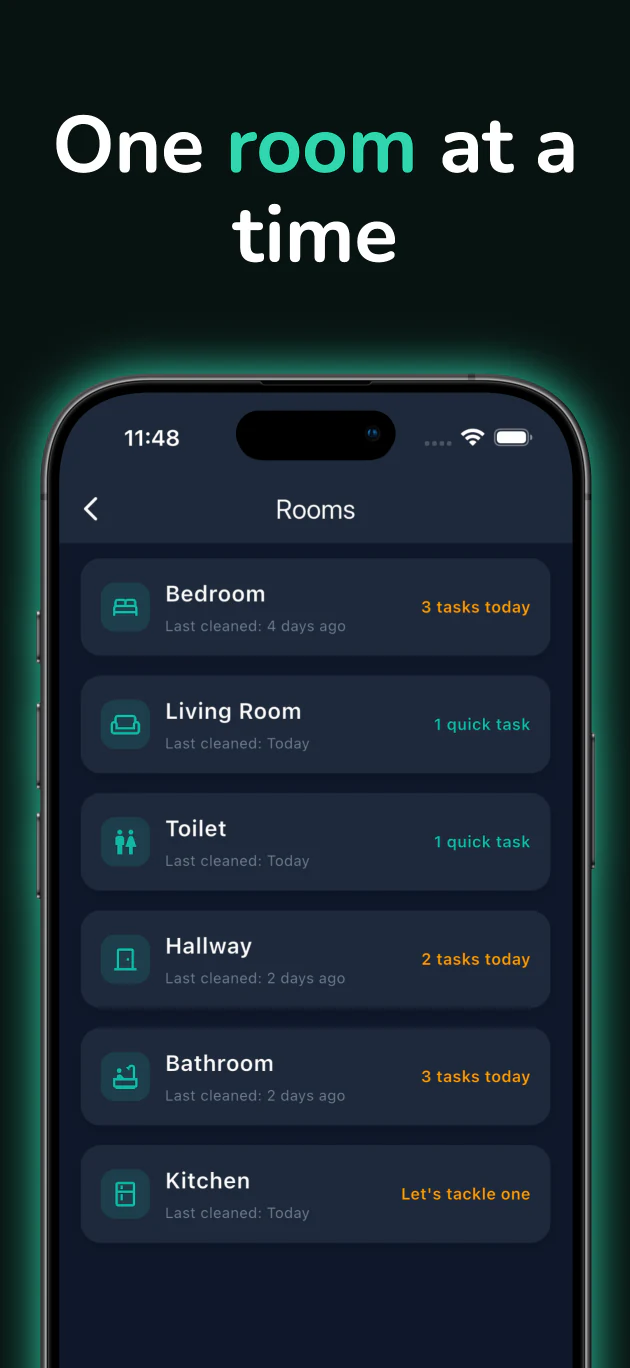
Natty House organises cleaning tasks by room; the screenshot shows named rooms, cleaning status and task counts. Its official App Store listing also describes a daily cleaning schedule and notifications for house-cleaning tasks. Natty is a free download with in-app subscriptions.
Use that cleaning workflow for the shelf or cupboard where the station lives. Keep recipient details, acceptance checks and drop-off plans on the handoff cards and in your own calendar. Clearing the station gives you access to the surface; Natty provides the room context for its cleaning upkeep.
Editorial note: the handoff card, departure check and seven-item example were prepared for this guide. They are planning tools, not a reported household trial. Oxfam GB's donation page and the Natty App Store listing were checked on October 22, 2026. Check your own recipient's current instructions before a handoff.