How to Organize Under the Bed: Measure, Sort and Zone
To organize under the bed, pull everything out, keep only things you need a few times a year or less, and store them in lidded containers that fit the measured clearance with room to slide. Put the items you reach for most at the foot or the open side, label each container on the end that faces you, and vacuum the floor under the bed each time you rotate the contents.
Below you will find a measuring step, a table of what belongs under a bed and what does not, a simple zone map, a hypothetical November swap and a short list of what to skip.
Empty the space and look at what was there
Slide everything out onto the bed or the floor beside it. Under-bed space tends to collect three kinds of things: items that were put there on purpose, items that rolled or were pushed there, and items that were hidden there before a visit. Sort them into four groups:
- Goes back under: things you use a few times a year or less and that store well flat, such as off-season clothes or a spare duvet.
- Belongs in another room: shoes you wear every week, chargers, books, mugs and anything that slid off a nightstand.
- Leaves the house: clothes that no longer fit, broken items and duplicates. Things in good condition can go to the donation station.
- Needs a decision: boxes you have not opened in a long time. Open each one now; a sealed box under the bed tends to stay sealed for years.
With the floor empty, vacuum the whole area under the bed, including the corners near the headboard and the wall.
Measure the clearance before you buy containers
Three numbers decide what fits:
- Height: from the floor to the lowest point of the frame or slats. Measure at the side rail and in the middle, since a center support beam is often lower than the edges.
- Depth from each open side: how far a container can slide in before it hits a leg, a support or the wall.
- Access: which sides you can actually reach. A bed pushed against a wall may have only one long side and the foot open, and a nightstand can block part of a side.
Choose containers about half an inch to an inch lower than the clearance so lids do not scrape the frame. If the clearance is very low, flat zip bags or shallow trays work better than boxes. If you want more room, bed risers raise the frame, but check that they suit your bed and that the bed is still stable before you load anything under it.
What to store under the bed and what to keep out
The best under-bed items are bulky, light, used rarely and easy to fold flat. Anything you need every day, anything heavy and anything that attracts dust or pests is better somewhere else.
On a narrow screen, scroll the table sideways to see all three columns.
| Item | Under the bed? | Why, or a better home |
|---|---|---|
| Off-season clothes | Yes | Light, foldable and needed twice a year at the swap |
| Spare duvet, blankets and sheet sets | Yes | Bulky but light; the guest bedding can live under the guest bed |
| Gift wrap and flat cards | Yes, in a long shallow bin | Rolls fit the length of a bed better than most shelves |
| Keepsakes you rarely open | Yes, in a lidded box | Label the end so you do not open every box to find one |
| Shoes you wear every week | No | Reaching under the bed every day gets old; keep them by the door or in the closet |
| Heavy items such as weights or books | No | Hard to slide out and easy to scrape the floor with |
| Food and snacks | No | They attract pests; keep them in the kitchen or pantry |
| Important papers | No | Keep them together in a folder or file box with your other documents |
| Open cardboard boxes | No | They collect dust and are hard to clean; use lidded plastic or fabric bins |
If gift wrap is the main thing you plan to keep under the bed, the gift wrapping supplies guide shows how to set it up as one portable kit.
Give the space zones by how often you reach in
Think of the area under the bed as three zones, ordered by how easily you can reach them:
- Open edge (foot or free side): what you open every month or two, such as gift wrap, a spare blanket or a box of hobby supplies. Wheeled bins or drawers work well here.
- Middle: what you open once a season, such as the off-season clothes bin.
- Far side and head end: what you open once a year or less, such as keepsakes or the summer duvet.
Label each container on the short end that faces out, not on the lid, so you can read it without pulling it out. Keep a short list of what is in each bin on paper or as a photo on your phone, and update it at every swap. Leave a strip of floor clear along the edges so you can vacuum without moving everything.
Example: a November clothing swap under a queen bed
This hypothetical household has a queen bed with both long sides open, a center support beam and nothing planned for the space except what had piled up. They set aside one Saturday morning.
- Step 1: pull everything out. They find two pairs of running shoes, a charger, three library books, a bag of summer clothes and an open box of old cards.
- Step 2: send the shoes to the entry, the charger to the nightstand and the books back to the library bag. Vacuum the empty floor.
- Step 3: measure the clearance at the rail and at the center beam, and buy containers that fit the lower of the two.
- Step 4: pack the summer clothes into one wheeled bin for the middle zone, and the old cards into a lidded box for the far side. A spare winter blanket goes in a flat bag at the foot, where it is easy to grab on a cold night.
- Step 5: label the ends, take a photo of the open bins and add the next swap to the calendar for spring.
In spring the same bins swap: winter clothes go into the middle bin and the summer clothes come out.
What to skip
- Buying storage before you measure. A bin that is half an inch too tall will not slide under the frame.
- Filling every inch. A packed space is hard to vacuum and turns into a place to hide clutter again.
- Vacuum-sealing items you need on short notice, like the guest bedding before a visit.
Keep the floor under the bed clean
Under-bed storage stays useful when it gets a quick check on a regular rhythm. Each month, pull out the open-edge bins, vacuum along the edges and put back anything that drifted. At each seasonal swap, take every container out, vacuum the whole area and wipe the lids. The bedroom cleaning schedule covers the rest of the room, and the closet cleaning schedule helps when the off-season clothes come back into the closet.
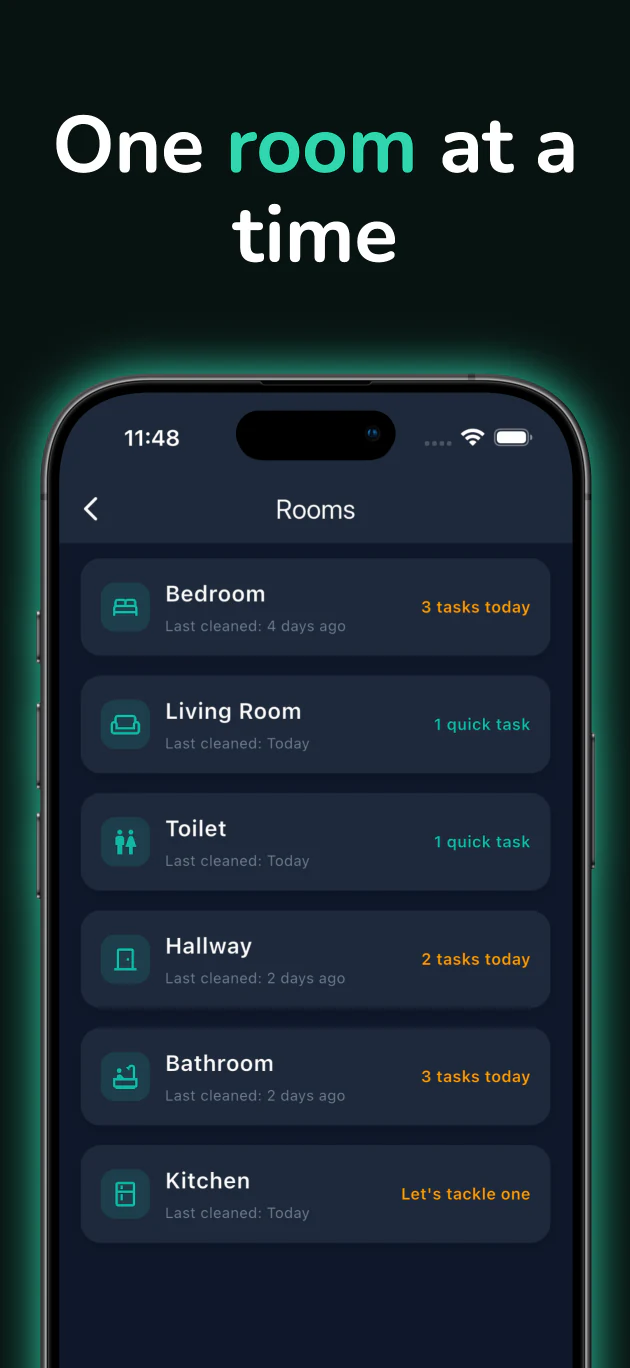
A monthly "vacuum under the bed" job is easy to forget because nobody sees that floor. Natty House organizes cleaning tasks by room; the screenshot below shows each room with when it was last cleaned and how many tasks are due today. Its official App Store listing also describes a daily cleaning schedule and cleaning-task notifications. Natty is a free download with in-app subscriptions.
Keep the list of what is in each bin on paper or in your own notes. Natty tracks cleaning tasks by room and does not track what is stored under the bed.
Under-bed storage FAQ
What is the best thing to store under a bed?
Items that are bulky, light and used a few times a year or less: off-season clothes, spare duvets and blankets, guest sheet sets, gift wrap in a long shallow bin and keepsakes in lidded boxes. Things you use every week are better kept where you can reach them standing up.
What should you not keep under your bed?
Food, heavy items such as weights or stacks of books, important papers, open cardboard boxes and anything you need every day. Food attracts pests, heavy items are hard to slide out, open boxes collect dust, and papers are easier to find in one folder with your other documents.
How often should you clean under the bed?
Vacuum along the edges and the open side about once a month, and take every container out to vacuum the whole area at each seasonal swap. Leaving a clear strip of floor along the edges makes the monthly pass quick.
Editorial note: the four-group sort, the storage table, the zone map and the November swap example were prepared for this article on November 13, 2026. The example household is hypothetical.