Unfinished Puzzle Storage: Clear the Table, Keep Your Place
To store an unfinished puzzle between sessions, plan a place for the whole working set: the assembly surface, loose-piece containers and reference picture. Check that each part fits its storage home before starting on a shared table.
This guide focuses on clearing a dining or living-room table while keeping a puzzle available to continue. The worksheet and pause routine are planning suggestions. The size comparison below uses published manufacturer specifications; the household example is hypothetical.
Check three different fits
Write down these measurements before choosing a storage arrangement. Use the actual puzzle and accessory instructions where available, with the same units for each comparison.
- Puzzle to working area. Compare the finished puzzle's width and height with the usable area inside the board, case or other assembly surface. Leave room for anything you intend to keep beside the assembled image, or assign those pieces separate containers.
- Whole accessory to storage space. Measure its outside dimensions, including the parts that stay attached when stored. Compare those with the clear space and opening of the proposed storage home. A board that fits the puzzle still needs somewhere to go.
- Loose pieces to their own home. Include every tray, box and reference sheet used during the session. If the board fits but the trays have nowhere to go, the table-clearing plan is incomplete.
Record a specific destination, such as a clear shelf section you can comfortably reach. Check the route and opening as well as the space inside. Use a storage position supported by the accessory's instructions; a close fit alone does not establish that it can be stored upright, stacked or carried in a particular way.
A real mismatch hidden by “1000 pieces”
Gibsons' official Puzzle Board page describes a board for up to 1000 pieces, specifies a usable puzzle area of 72 × 49 cm and lists outside dimensions of 77 × 55 cm. These are two different measurements for two different checks.
Ravensburger's official listing for The Fantasy Toy Shop, model 12000006, gives 1000 pieces and a finished footprint of 70 × 50 cm. On those published dimensions, it does not fit the Gibsons board's 72 × 49 cm working area: the 50 cm side exceeds 49 cm. Rotating it would put the 70 cm side across that 49 cm space.
This is a comparison of specifications, not a hands-on test or a recommendation to buy either product. It shows why the piece count cannot settle your fit check. Read the measurements for the exact puzzle and accessory you have, then measure the place where the complete accessory will be stored.
Rehearse the empty setup first
Before opening a new puzzle, place the empty assembly surface and containers on the table. Check that the setup leaves the working room you want. Then put each empty component into its proposed storage home, following its instructions. Bring everything back to the table once.
If a shelf opening is too narrow, a door will not close or one tray has to stay on a dining chair, revise the arrangement before adding pieces. Choose a different available space or a puzzle and setup that fit. Keep the table's next use in mind: the finish line is a usable table and a complete stored set.
If your current puzzle is already assembled directly on the table, this rehearsal is for the next setup. Do not assume instructions for storing a puzzle on a purpose-made board explain how to transfer it from a bare table. Check for a method documented for your exact equipment; if none is available, agree to keep that surface occupied until you finish or choose to dismantle the work. The checklist here does not provide a transfer technique.
Keep one short pause note with the pieces
Label the separate containers with the same puzzle name. Add a small note that explains where the set lives and what you intend to work on next. You can copy these lines onto paper:
Puzzle / exact model: ____________________
Finished size / usable assembly area: ____________________
Outside dimensions / storage home: ____________________
Loose-piece containers and their homes: ____________________
Reference picture location: ____________________
Next section to work on: ____________________
Use a description such as “red roof pieces in tray A; start left of the chimney.” If you take a progress photo, keep it with your own puzzle notes and make its location clear. The note only needs enough detail to restart; counting every remaining piece is optional.
Worked example: one board and two trays
Imagine a person who has checked that their puzzle fits their existing board and that the empty board fits its intended storage position. They use two loose-piece trays, A and B, with separate assigned spaces in a nearby cupboard. The reference picture and pause note live in the puzzle box. This is an invented layout, not a tested storage capacity.
- Before pausing: the person writes “next: red roof” and notes which tray holds those pieces. They account for the board, both trays and the box.
- Putting away: they secure and move each component as its instructions allow. Both trays return to their assigned cupboard spaces; the board goes to its checked home.
- Checking the room: the table and chairs are available again. Any loose piece found during the reset goes back to the matching puzzle's container before room cleaning begins.
- Restarting: they bring back the board, trays A and B, and the box. The note identifies the next section without requiring every piece to be sorted again.
If tray B is still missing at restart, check its recorded home and the last working surface before starting a second sorting system. If it was left on a chair because its cupboard space was full, fix that space allocation. A spare container would otherwise conceal the incomplete return.
Use this table-clearing check
- The puzzle's finished dimensions fit the usable assembly area.
- The complete accessory fits its planned storage space in a permitted position.
- Every loose-piece container has a named home and is accounted for.
- The reference picture and next-section note can be found at restart.
- The table and seating are available for their next use.
Once the set is put away, use the dining-room cleaning guide for the surrounding table, chairs and floor, or the living-room guide for a shared coffee-table area. For the care document belonging to your furniture or accessory, the manual-index method offers a way to record where the relevant instructions are kept.
Connect the cleared surface to room cleaning
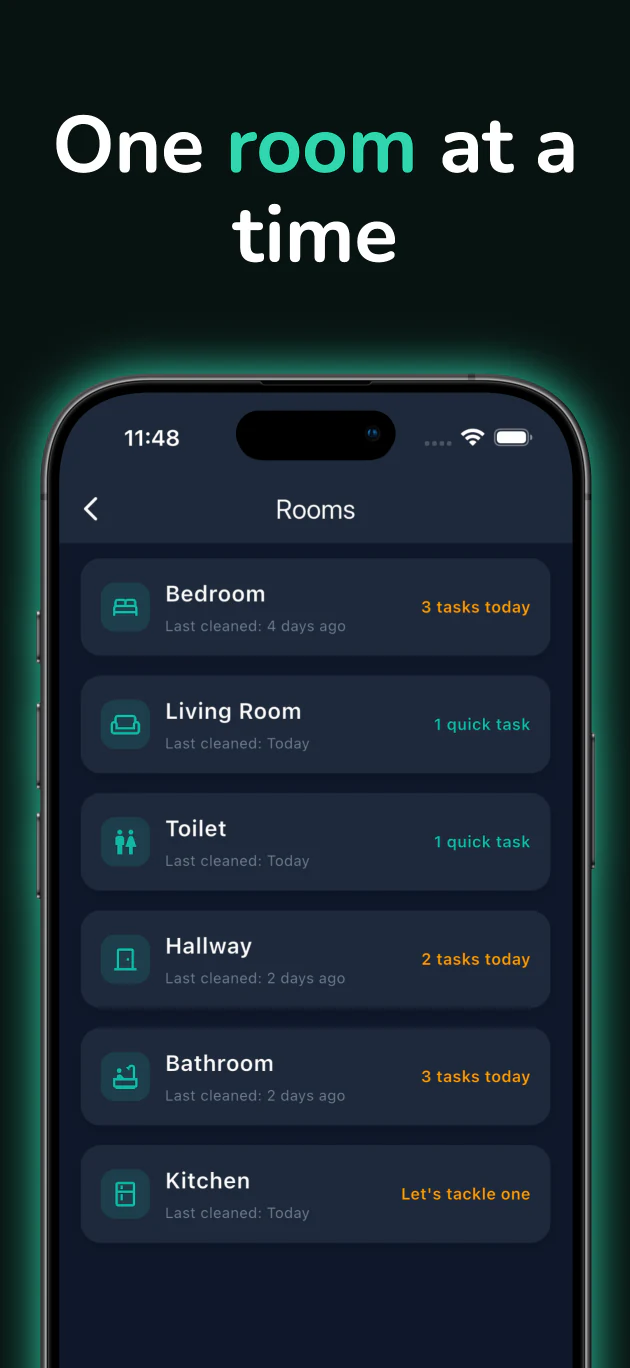
Natty House organises cleaning tasks by room; the screenshot shows room names, cleaning status and task counts. The official App Store listing also describes a daily cleaning schedule and cleaning-task notifications. Natty is a free download with in-app subscriptions.
Use that room-cleaning workflow once the table is accessible. Keep the puzzle measurements, tray locations and pause note on paper or in your own files. The puzzle set makes room for the cleaning task; Natty supplies the room context for that upkeep.
Editorial note: manufacturer specifications and the Natty listing were checked on October 23, 2026. The worksheet, empty-setup rehearsal and two-tray example were prepared for this guide. No physical product test, preservation guarantee or household trial is reported.