How to Organize Board Games: Sort, Shelve and Keep the Pieces
To organize board games, take every game off the shelf, check that each one is complete, and sort them by how often you play. Give the favorites the easiest shelf, bag the small pieces inside each box, stand standard boxes upright like books and stack only the large or odd-shaped ones flat. A short put-away check after each game night keeps the system working.
Below you will find a sorting step, a table that matches each group of games to a place in the room, a rule for upright versus stacked boxes, a game-night put-away check and a hypothetical December example for making room before new games arrive.
Take every game out and check what is inside
Clear the shelf or cabinet completely and set the games on a table or the floor. Open each box and compare the contents with the component list printed in the rules, if there is one. Then sort the games into four piles:
- Played in the last few months: these go back first and get the best spots.
- Kept but rarely played: party games for big groups, long strategy games, a game you only bring out with one friend.
- Incomplete: missing cards, dice or a player color. Decide whether the game still works without the missing parts.
- Ready to leave: games nobody chooses anymore and games the kids have outgrown. Complete ones can go to the donation station.
Loose pieces found at the bottom of the cabinet go into one small container while you sort. Most of them will find their box during the component check.
Give each group of games a place
Keep all games in one area of the house if you can, so nobody has to remember three different shelves. Inside that area, place games by how often they come out and who plays them.
On a narrow screen, scroll the table sideways to see all three columns.
| Group | Where it goes | How to store it |
|---|---|---|
| Current favorites (3 to 6 games) | Eye level or the shelf closest to where you play | Upright, titles facing out, nothing stacked on top |
| Kids' games | A low shelf the kids can reach on their own | Upright, with pieces bagged so a tipped box does not spill |
| Card and small-box games | One basket or bin on the same shelf as the favorites | Grouped together so they do not slip behind larger boxes |
| Party and group games | A higher shelf or the back of the cabinet | Upright; move them forward before you host |
| Large or heavy boxes | The lowest sturdy shelf | Flat, heaviest at the bottom, short stacks only |
| Rarely played keepers | Top shelf, closet or a lidded bin elsewhere | Labeled on the visible end so you can find one without unpacking all |
| Incomplete games | A single "decide" bin, not the main shelf | With a note of what is missing; review it at the next sort |
Rotate the favorites shelf every few weeks. When a game drops out of rotation, it moves one shelf up and another comes down.
Stand boxes upright or stack them flat?
Upright storage works like a bookshelf: you read every title at a glance and pull one game out without lifting the others. It suits most standard square boxes. Before you turn a box on its side, put loose pieces in bags or small containers so they stay in their compartments, and use a box band or a wide elastic if the lid slides off.
Stack flat when a box is oversized, very heavy, or the shelf is too short for it to stand. Keep stacks short, put the heaviest box at the bottom, and leave the most played game on top. A tall stack means lifting four games to reach the fifth, and that game usually stops getting played.
Keep the pieces together inside each box
- Bag pieces by use: one small zip bag per player color, one for cards, one for shared tokens. Clear bags let you see what is inside.
- Keep dice and very small parts in a tiny container so they do not work their way out of a bag corner.
- Put the rules on top of everything else in the box, folded the same way each time.
- If the original insert broke or never fit the bagged pieces, replace it with a few small containers rather than a pile of loose bags.
- Write the game name on any bag that could end up in the wrong box.
Keep one small "found pieces" jar on the game shelf. Anything found under the sofa or between cushions goes there, and you return those pieces to their boxes the next time you sort.
A two-minute put-away check after game night
Most lost pieces disappear during cleanup, when everyone is tired. Before a game goes back on the shelf:
- Look under the table, around chairs and between sofa cushions.
- Count the pieces that matter most, such as each player's set or the special dice.
- Bag pieces the same way they came out and put the rules on top.
- Close the lid fully and return the box to its own spot, not the nearest open gap.
If several games come out in one evening, put each one away before opening the next. A table covered in open boxes is where pieces swap games.
Make room before new games arrive
Birthdays and the winter holidays often add several games at once. Before that happens, count how many more boxes the shelf can hold. If the answer is fewer than the games you expect, take the same number out of the "rarely played" and "ready to leave" groups now, while you still have time to drop them off. A one-in, one-out rule after that keeps the shelf from overflowing again.
Example: a living room cabinet in early December
This hypothetical household keeps 24 games in a two-shelf living room cabinet. Boxes are stacked six high, and the kids expect a few new games over the holidays. One evening they:
- Empty and check: 24 games come out. Two are missing parts that the game cannot do without, and three have not been played in over a year.
- Decide: the two broken games go in the recycling after the spare dice and timers are kept for the found-pieces jar. Two of the unplayed games go to the donation bag; one stays as a rarely played keeper.
- Place: five favorites stand upright on the top cabinet shelf, kids' games stand on the bottom shelf, card games go into one basket, and the three biggest boxes lie flat in a short stack.
- Leave space: with 20 games left, there is a gap of about four boxes for whatever arrives in December.
What to skip
- Buying custom inserts or new furniture before you sort. Many collections fit once the unplayed games leave.
- Throwing away every original box. It saves space, but the game is harder to recognize, lend or donate later.
- Filling every inch of the shelf. A small gap makes it easy to put a game back in its own spot.
Keep the game shelf in your room routine
Box tops collect dust, and stray pieces end up under furniture. A monthly dust of the shelf and the box tops, plus a vacuum around the play area, keeps the cabinet pleasant to open. The living room cleaning schedule covers the rest of the room, the playroom cleaning schedule has an evening reset for kids' spaces, and if jigsaws share the same table, the unfinished puzzle storage guide shows how to clear it without losing your place.
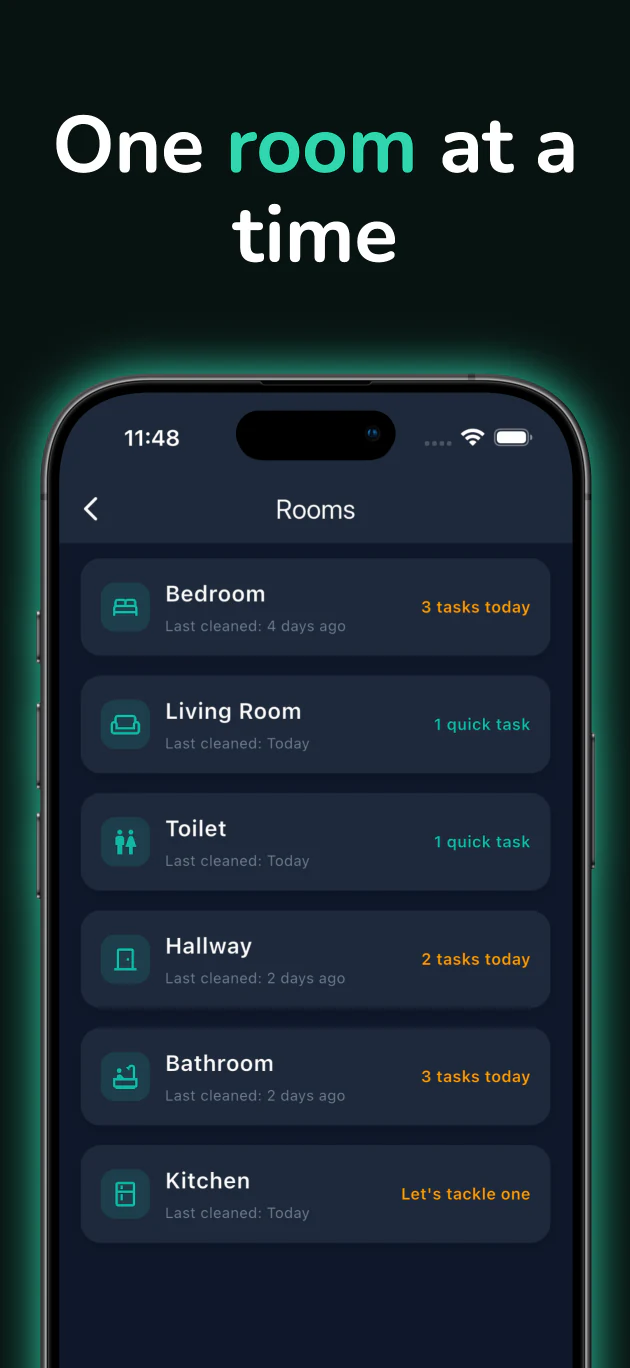
A "dust the game shelf" job is easy to forget because it is never urgent. Natty House organizes cleaning tasks by room; the screenshot below shows each room with when it was last cleaned and how many tasks are due today. Its official App Store listing also describes a daily cleaning schedule and cleaning-task notifications. Natty is a free download with in-app subscriptions.
Natty tracks cleaning tasks by room. It does not keep a list of your games or their pieces, so keep any game list on paper or in your own notes.
Board game organization FAQ
Should board games be stored vertically or horizontally?
Standard square boxes are easiest to use stored upright like books: you can read every title and pull one out without lifting the others. Bag the loose pieces first and use a box band if the lid slides. Store oversized or heavy boxes flat in short stacks with the heaviest at the bottom.
How do you keep board game pieces from getting lost?
Bag pieces by player color, cards and shared tokens, keep dice in a tiny container, and check under the table and sofa cushions before each game goes back in its box. A small found-pieces jar on the game shelf catches strays until the next sort.
What should I do with board games that are missing pieces?
Put them in one decide bin with a note of what is missing. If the game still plays well without those parts, return it to the shelf. If it does not, keep any useful spare dice or timers and let the rest go. Donate only complete games.
Editorial note: the four-pile sort, the shelf plan table, the put-away check and the December cabinet example were prepared for this article on November 20, 2026. The example household is hypothetical.